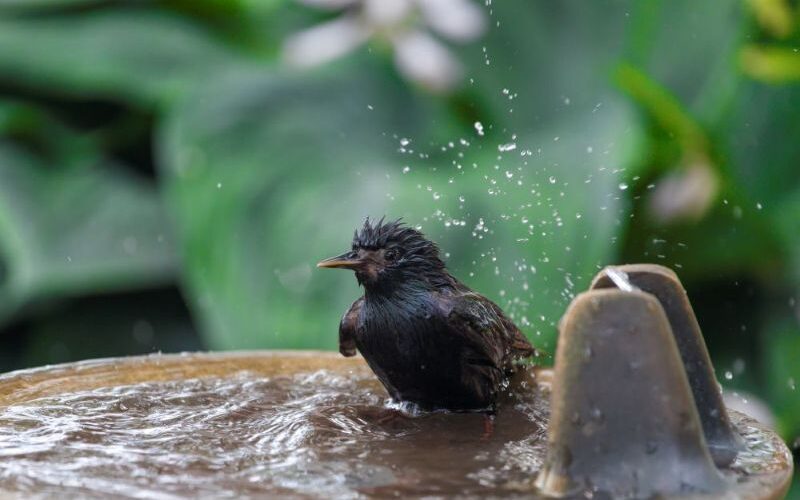
Every November, my neighbor Linda — a retired schoolteacher from Ohio — does the same thing. She unplugs her garden hose, puts the patio furniture in the garage, and then stares at her bird bath with a sigh. “I always feel guilty,” she told me once. “The birds still show up every morning, looking for water, and all they find is a block of ice.”
Linda’s not alone. Millions of U.S. bird lovers face this exact problem every winter. And the fix is simpler — and more affordable — than most people think.
Why Water Matters More Than Food in Winter
Most people load up their feeders the moment temperatures drop. That’s great. But here’s something that often surprises new birders: fresh, liquid water is actually harder for birds to find in winter than food.
According to the Cornell Lab of Ornithology, birds need water year-round not just for drinking but for preening — which keeps their feathers properly aligned for insulation against cold. A bird with dirty, matted feathers loses heat fast. That’s not a small inconvenience. In a bad freeze, it can be life-threatening.
Natural water sources freeze over. Puddles disappear. Streams slow to a trickle. Your backyard? It could be the only reliable water source within half a mile.
That’s where a heated bird bath comes in.
What Is a Heated Bird Bath, Exactly?
A heated bird bath is exactly what it sounds like — a bird bath with a built-in or attached heating element that keeps the water just above freezing. We’re not talking about a hot tub for robins. The goal is simply to prevent ice from forming.
There are two main types:
1. Integrated heated bird baths — These come with a built-in bird bath heater thermostatically controlled to kick on only when temps approach freezing. They’re energy efficient; most draw between 50 and 150 watts, roughly the same as a standard light bulb.
2. Add-on de-icers — If you already love your existing bath, you can drop in a submersible bird bath heater (also called a de-icer) to convert it into a heated bird bath for winter use. These typically run $20–$40 and work with most standard baths.
The Solar Option — Clean, Cord-Free, and Clever
If you cringe at the idea of running an extension cord across your yard all winter, you’re going to love the solar bird bath heater.
A solar heated bird bath uses photovoltaic panels — either built into the bath or mounted nearby — to power a small heating element. No cords, no electricity bills, no tripping hazard across the lawn.
There’s a catch, though: solar works best in areas that still get decent sun in winter, even if it’s cold. If you’re in a state like Colorado or Tennessee where winter days are cold but sunny, a solar bird bath heater can be an excellent year-round solution. If you’re in Seattle or upstate New York where gray skies dominate November through February, you may want to pair solar with a backup electric option.
My own setup — a solar heated bird bath mounted on a cedar post — started attracting birds I’d never seen before in winter. A pair of Eastern Bluebirds showed up in January. My bird-watching journal still has that entry circled in red.
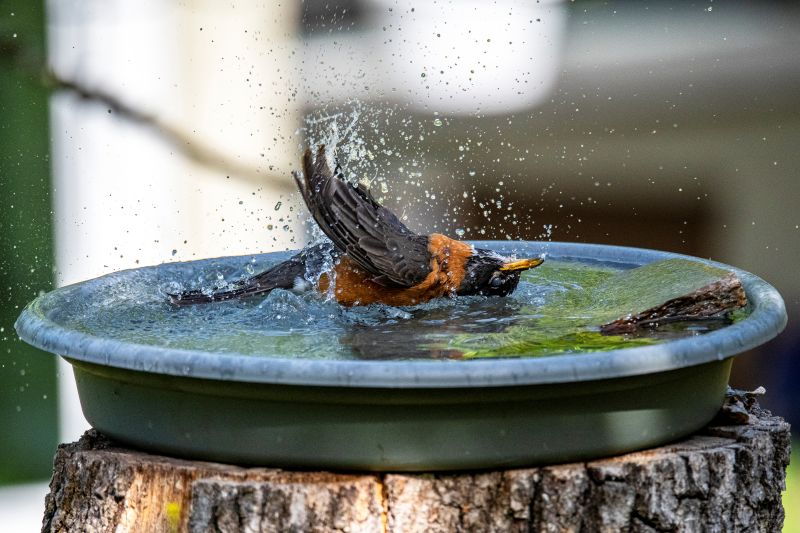
5 Practical Tips for Getting the Most Out of Your Heated Bird Bath
Keep it shallow. Most songbirds prefer water that’s 1–2 inches deep. If your bath is deeper, add a flat stone to the center.
Place it near cover, not right under a feeder. Birds like to be close to shrubs or trees where they can retreat quickly. But placing it directly under a feeder means debris and seed hulls contaminate the water fast.
Clean it weekly. A heater keeps water liquid, but it doesn’t keep it clean. Algae and bacteria still grow. A quick scrub with a stiff brush and a diluted white vinegar rinse works well — avoid soap, which leaves residue harmful to birds.
Use a GFCI outlet for electric models. Anytime you’re using electricity near water outdoors, a ground fault circuit interrupter outlet is a safety non-negotiable.
Position it in partial shade. Even in winter, direct afternoon sun can cause algae growth and evaporation. A spot that gets morning sun and afternoon shade tends to work well.
What Do Bird Lovers Actually Say?
Tom R., a birder from suburban Minneapolis, switched to a heated bird bath for winter three seasons ago after years of hauling boiling water outside every morning to thaw his bath. “It sounds small,” he says, “but it changed my whole winter routine. I get my coffee, look out the window, and there are always birds. Chickadees, nuthatches, even a fox sparrow this past February. I don’t know how I went without it.”
His model? A 75-watt thermostatically controlled basin bath that only activates below 35°F. His electric cost for the whole winter season? About $9.
Frequently Asked Questions
Q: Will a heated bird bath attract more birds in winter? Yes — noticeably so. Open water is rare in freezing temperatures, and birds have strong instincts to find it. A consistently ice-free bath can become a hub of activity that draws species you might never see at a feeder alone.
Q: Is it safe to use an electric bird bath heater outside? Yes, provided you use a model rated for outdoor use (look for UL-listed products) and plug it into a GFCI-protected outlet. Never use an indoor extension cord outside.
Q: How warm should the water be in a heated bird bath? Just above freezing — around 35–40°F. The point is to prevent ice, not to warm the water significantly. Birds actually prefer cooler water.
Q: Can I use a solar bird bath heater in cold, cloudy climates? You can, but with limitations. In very cloudy regions, a solar bird bath heater alone may not provide enough power on overcast days. Consider a hybrid model or keep a plug-in de-icer as backup.
Q: How deep should the water be? One to two inches is ideal for most backyard songbirds. Larger birds like doves and robins can handle up to three inches, but shallower is safer for smaller species.
Q: Do I need to run my heated bird bath all winter? Run it anytime temperatures are expected to drop below 32°F. Most thermostatically controlled models do this automatically, so you don’t have to think about it at all.
The Bottom Line
Birds don’t ask much of us. They show up, they sing, they do their thing — and honestly, watching them get through a hard winter feels like a small victory you get to share. A heated bird bath is one of the most practical, high-impact additions you can make to a winter backyard setup. Whether you go electric or invest in a solar heated bird bath, the birds will find it. And they’ll keep coming back.
Linda finally got one last October. She texted me a photo in December — six American Robins crowded around it in the snow. “Best $45 I ever spent,” she said.
Hard to argue with that.